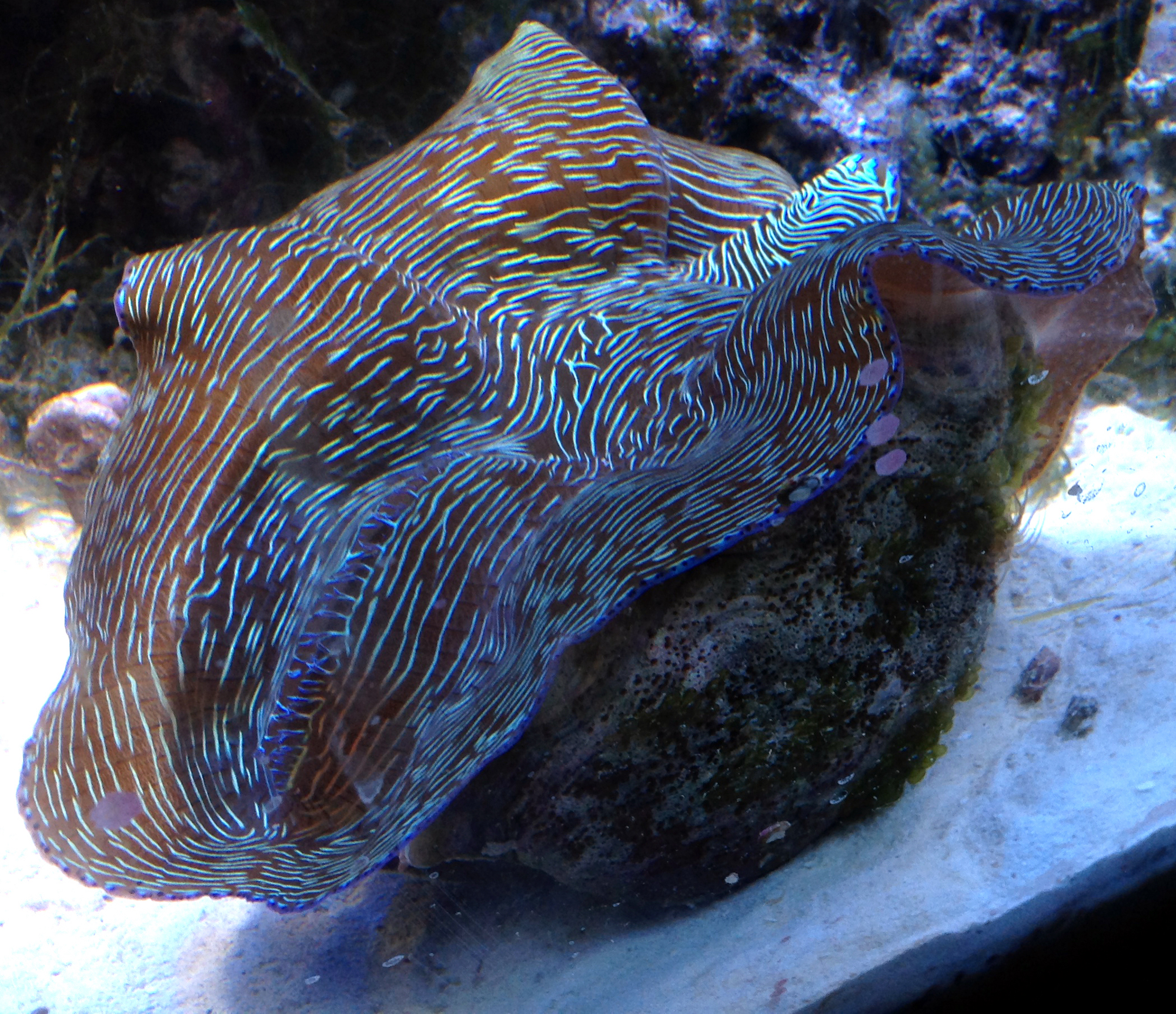
The derasa clam is the second largest species of the genus Tridacna, growing up to 60cm in shell length.
The thick, plain-colored shells of this species have almost no ribbing and typically have shallow folds.
The derasa clam’s mantle is brightly colored, often displaying shades of blue and green with striped patterns.
Habitat
Wide range of habitats, including reef flats, fore reefs, barrier reefs, and atoll lagoons to depths of 20m.
Diet
Through photosynthesis, zooxanthellae, a symbiotic algae that live in the clam’s tissues, provide derasa clams with nutrients.
Life History
Like other species of giant clams, derasa clams are simultaneous hermaphrodites. This means that an individual has both male and female reproductive organs, allowing them to produce both sperm and eggs at the same time. During spawning sperm and eggs are released into the water. It was recorded that derasa clams living in the Great Barrier Reef spawn in the late spring to early summer.
This species begins its life as a fertilized egg which develops into free-swimming larva. This larva then transforms into a juvenile clam, settling on the seafloor.
IUCN Status
Endangered
Ecosystem & Cultural Importance
Derasa clams contribute to the well-being of coral reef ecosystems by releasing zooxanthellae which then become available for other zooxanthellate-dependent species to ‘take up’.
Derasa clams can provide additional shelter via their shell surfaces to surrounding organisms. They are also known to host pontoniinid shrimps.
Over-harvesting has contributed to the decline of this species. This species is highly favored for its meat as food and large shells. Derasa clams are also likely vulnerable to climate change, habitat destruction, poor water quality and diseases.
Found from the Cocos (Keeling) Islands to Tonga and from China to Queensland, Australia. Native populations in five geographic regions are extinct or possibly extinct, impacting possibly 75% of its recent historical range.
This animal is not native to the Oregon Coast, however is found in the larger Pacific Ocean. It lives in the Aquarium as part of our Connected Coasts gallery.
This species’ large shells along with shells of other giant clams, were previously collected for the highly popular floor-tile industry in Central Java, Jakarta, and East Java.
Citations & Other Resources
Neo, M.L. and R. Li. 2024. Tridacna derasa. The IUCN Red List of Threatened Species 2024
WDavis1911 (https://commons.wikimedia.org/wiki/File:Tridacna_derasa_in_aquarium.jpg), „Tridacna derasa in aquarium“, https://creativecommons.org/licenses/by-sa/3.0/legalcode
We use cookies to improve your experience and see how our guests are navigating the website. If this is alright by you, hit 'Accept All', or 'Settings' to customize and learn more.
Read our cookie policy