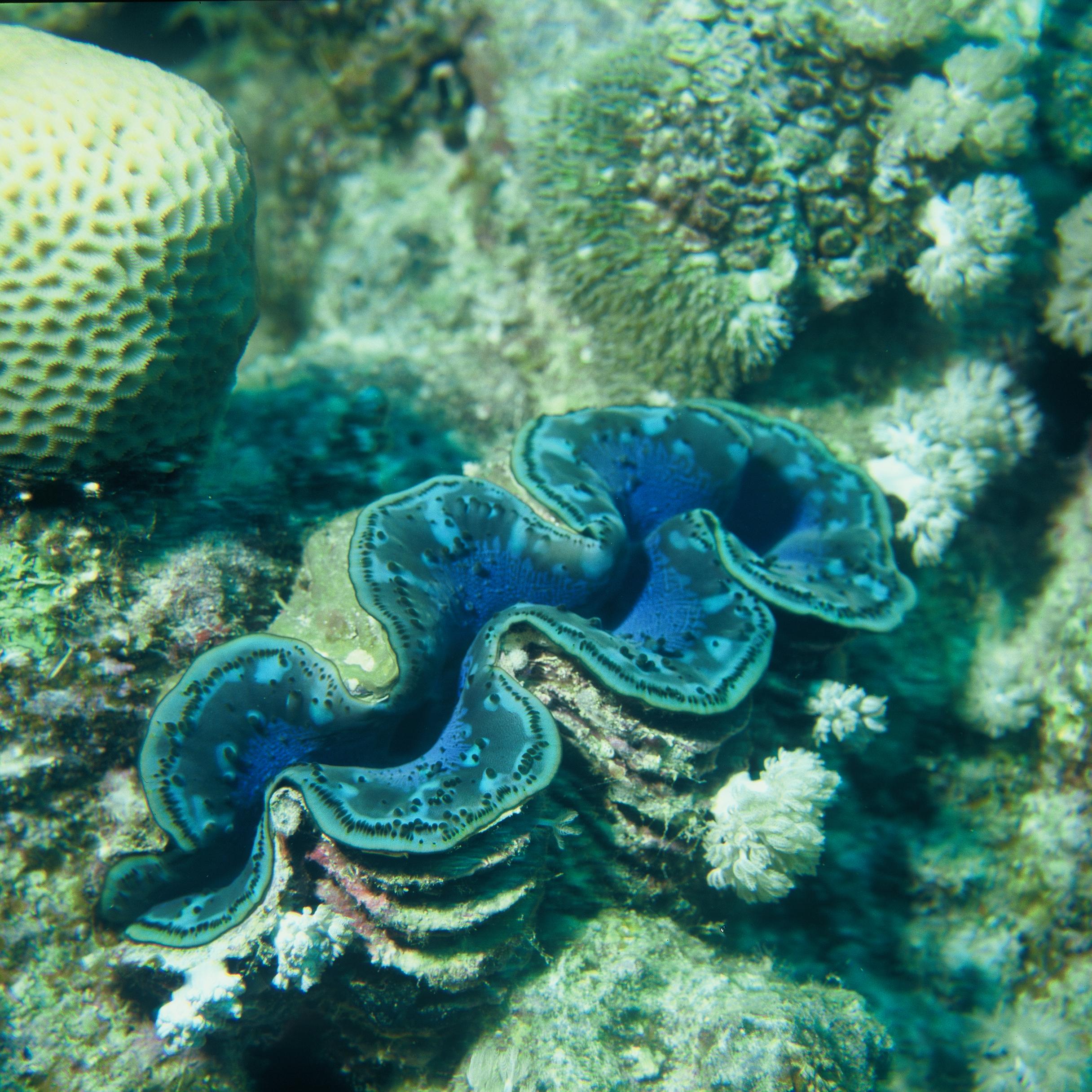
The shell of the maxima clam is thick and heavy with 4 to 6 folds.
The mantle is brightly colored usually blue, green and brown and marked with spots. Its eyes, sometimes referred to as hyaline organs, typically form a tightly spaced row along the margin of the mantle.
The maxima clam has been recorded to grow up to 40cm but this species typically grows up to 5 to 15cm.
Habitat
Shallow areas of reefs and lagoons, rarely beyond a depth of 10m.
Diet
Zooxanthellae, microscopic algae that live within their tissues and photosynthesize, providing the clam with energy.
Life History
All species of giant clams are known to be simultaneous hermaphrodites. This means that an individual has both male and female reproductive organs, allowing them to produce both sperm and eggs at the same time. During spawning sperm and eggs are released into the water.
This species begins its life as a fertilized egg which develops into free-swimming larva. This larva then transforms into a juvenile clam, settling on the seafloor.
Juveniles are usually fully embedded in the reef substratum. As this species grows they become only partially embedded.
IUCN Status
Least Concern
Ecosystem & Cultural Importance
This species is often studied in ecological studies to investigate the growth, survival and behavior of juvenile clams.
Giant clams produce calcium carbonate that contributes to the construction of the reef and through a symbiotic relationship with algae they recycle nutrients.
This species is also known to host cyclopoid copepod species, pea crabs and pontoniinid shrimps.
The maxima clam is harvested across its range for local consumption. In Sabah-Malaysia, giant clams are regularly consumed as traditional food cuisines. In Palau maxima clam shells are sold as earrings, pins and shell crafts.
This animal is not native to the Oregon Coast, however is found in the larger Pacific Ocean. It lives in the Aquarium as part of our Connected Coasts gallery.
The maxima clam and the fluted giant clam (Tridacna squamosa) are the widest ranging giant clam species, extending from East Africa to the Central Pacific.
Citations & Other Resources
Neo, M.L. and R. Li. 2024. Tridacna maxima. The IUCN Red List of Threatened Species 2024.
Van Wynsberge, S., S. Andréfouët, N. Gaertner-Mazouni, C.C.C. Wabnitz, A. Gilbert, G. Remoissenet, C. Payri, and C. Fauvelot. 2016. Drivers of density for the exploited giant clam Tridacna maxima: a meta-analysis. Fish and Fisheries (Oxford, England), 17(3), 567–584. https://doi.org/10.1111/faf.12127
Lee, L. K., M.L. Neo, Z.F. Lim, K.S. Hii, H.C. Lim, A.A. Chan, H. Gu, P.T. Lim, and C.P. Leaw. 2022. Population status and genetic diversity of two endangered giant clams (Tridacna squamosa and Tridacna maxima) on the fringing reefs of Perhentian Islands, Malaysia. Aquatic Conservation, 32(6), 1005–1021. https://doi.org/10.1002/aqc.3807
Rossbach, S., B.C.C. Hume, A. Cárdenas, G. Perna, C.R. Voolstra, and C.M. Duarte. 2021. Flexibility in Red Sea Tridacna maxima‐Symbiodiniaceae associations supports environmental niche adaptation. Ecology and Evolution, 11(7), 3393–3406. https://doi.org/10.1002/ece3.7299
Militz, T. A., R.D. Braley, and P.C. Southgate. 2017. Captive Hybridization of the Giant Clams Tridacna maxima (Röding, 1798) and Tridacna noae (Röding, 1798). Journal of Shellfish Research, 36(3), 585–591. https://doi.org/10.2983/035.036.0306
We use cookies to improve your experience and see how our guests are navigating the website. If this is alright by you, hit 'Accept All', or 'Settings' to customize and learn more.
Read our cookie policy