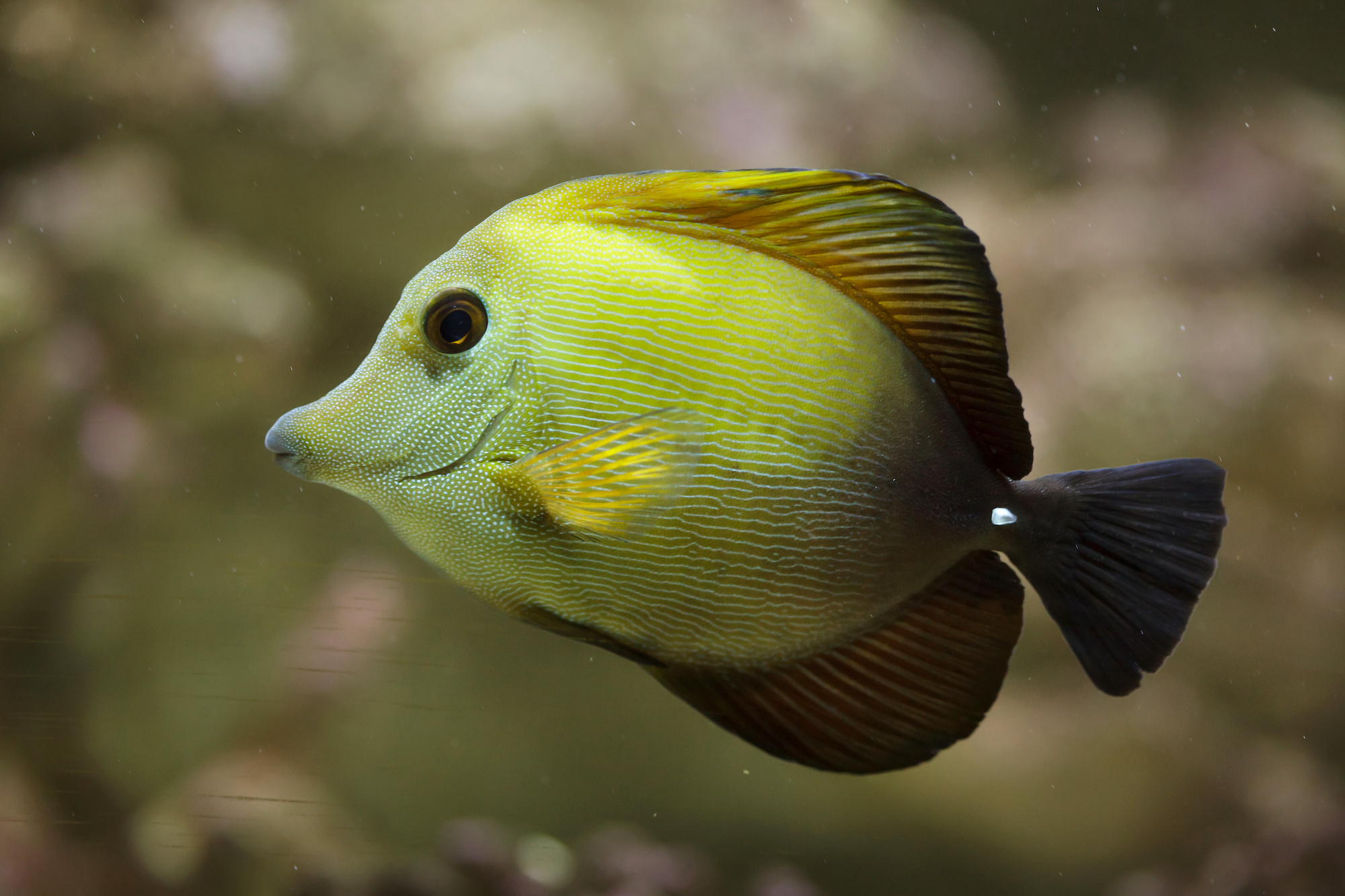
The scopas tang has a dense patch of bristle-like setae located near the base of its tail fin. Setae are longer in males than females. Males of this species also tend to be larger than females in general.
Adults have a triangular tail fin with a flat edge while juveniles have a more rounded tail fin. This species’ fins are dark brown except for the pectorals which are transparent.
The scopas tang’s head is yellowish brown which fades into dark brown on the back half of its body. The scopas tang also has pale blue dots on its head and the front part of its body. These dots form longitudinal rows of solid irregular lines in the middle of its body.
Juveniles are similar in color to adults, but they have 18 vertical pale yellow lines on their bodies.
Habitat
Coastal, lagoon, and outer reefs in areas with lots of coral. Lives at depths between 1 and 60m.
Diet
Algal turf mainly thallate and filamentous red and green algae.
Life History
This species forms spawning aggregations, releasing eggs and sperm into the water. The eggs float and drift with ocean currents, then once they hatch they become larvae. The young scopas tang continues to drift with currents eventually settling near reefs.
Juveniles tend to live in areas with high coral cover. The scopas tang grows rapidly for the first three to four years of its life, then growth declines.
In the Great Barrier Reef it was recorded that this species can live up to 33 years.
IUCN Status
Least Concern
Ecosystem & Cultural Importance
Scopas tangs are caught in subsistence fisheries, meaning that they are used for food by who caught them rather than being sold or traded.
This species helps maintain the health of coral reefs by consuming algae that could impact coral growth.
From East Africa and Gulf of Aden to French Polynesia and the Pitcairn Islands except Marquesas, northwards to Suruga Bay, Honshu, Japan and southwards to the Abrolhos Island, Western Australia, Lord Howe Island, Norfolk Island and Rapa.
This animal is not native to the Oregon Coast, however is found in the larger Pacific Ocean. It lives in the Aquarium as part of our Connected Coasts gallery.
The scopas tang has been known to interbreed with a similar species Zebrasoma flavescens, the yellow tang.
In Latin scopa means thin twigs or broom, which this name probably refers to the bristle-like setae on the side of this species body.
Citations & Other Resources
Abesamis, R., J.H. Choat, J. McIlwain, K.D. Clements, R. Myers, L.A. Rocha, C. Nanola, B. Russell, and B. Stockwell. 2012. Zebrasoma scopas. The IUCN Red List of Threatened Species 2012.
Randall, J. E. 2001. Surgeonfishes of the world. Mutual Pub.
We use cookies to improve your experience and see how our guests are navigating the website. If this is alright by you, hit 'Accept All', or 'Settings' to customize and learn more.
Read our cookie policy