Other Common Names There are 20 species belonging to the Paracheilinus genus including the Eightline Flasher Wrasse (Paracheilinus octoaenia), McCosker’s Flasher Wrasse (Paracheilinus mccoskeri), Yellowfin Flasher Wrasse (Paracheilinus flavianalis), Spot-lined Flasher (Paracheilinus lineopunctatus), Bell’s Flasher (Paracheilinus bellae), Angular Flasher (Paracheilinus angulatus) and Filamented Flasher Wrasse (Paracheilinus filamentosus).
There are 20 species belonging to the Paracheilinus genus including the Eightline Flasher Wrasse (Paracheilinus octoaenia), McCosker’s Flasher Wrasse (Paracheilinus mccoskeri), Yellowfin Flasher Wrasse (Paracheilinus flavianalis), Spot-lined Flasher (Paracheilinus lineopunctatus), Bell’s Flasher (Paracheilinus bellae), Angular Flasher (Paracheilinus angulatus) and Filamented Flasher Wrasse (Paracheilinus filamentosus).
At the Aquarium
Connected Coasts
Appearance
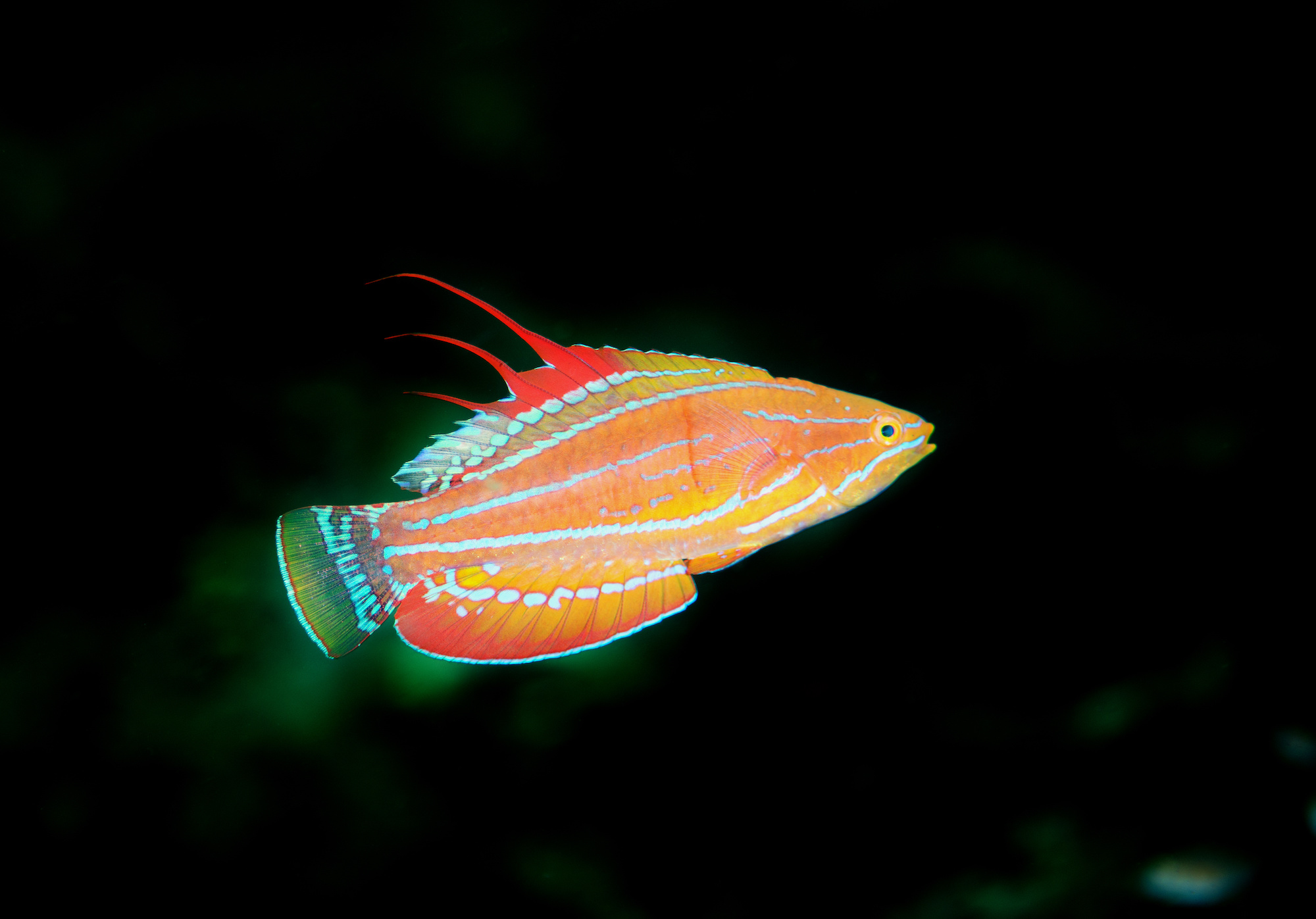
Species of flasher wrasse are small, usually under 70 mm in length. These species are very colorful and known for their courtship displays during which males temporarily “flash” iridescent colors.
Flasher wrasse are usually brownish-red in color.
Many species have a horizontal stripe pattern on their bodies.
Habitat
Rubble bottoms or algal beds of outer reef slopes at the depth of 5 to 70m.
Diet
Zooplankton and other tiny invertebrates
Life History
Males will perform a courtship display by flashing iridescent colors, rapidly swimming and raising their dorsal and anal fins. This behavior is most apparent a few hours before sunset, but males will readily display this behavior throughout the day.
Members of the Paracheilinus genus are protogynous hermaphrodites meaning that they are born female and at some point in their lifespan change sex to male. Flasher wrasse form large groups of tens to hundreds of individuals, with females greatly outnumbering males. These social groups are called harems and a dominant male protects and controls the group. In the absence of a male, usually the largest female changes sex to become the new dominant male.
Flasher wrasses are broadcast spawners, releasing eggs and sperm into the water. Fertilized eggs hatch and drift with ocean currents as larvae. Eventually the young flasher wrasse settle, finding their way to the bottom of reef habitats.
IUCN Status
Least Concern
Ecosystem & Cultural Importance
Flasher wrasse contribute to coral reef food webs by controlling populations of small invertebrates while also acting as prey for larger reef fish.
This animal is not native to the Oregon Coast, however is found in the larger Pacific Ocean. It lives in the Aquarium as part of our Connected Coasts gallery.
Species of Paracheilinus are popular subjects for underwater photography.
Citations & Other Resources
Kodeeswaran, P., T.T. Ajith Kumar, and K.K. Lal. 2023. First Report on Two Labrid Fishes of the Genera Cirrhilabrus and Paracheilinus from the Bay of Bengal, India. Thalassas : Revista de Ciencias Del Mar, 39(2), 961–970. https://doi.org/10.1007/s41208-023-00604-y
Tea, Y.-K., and F. Walsh. 2023. Review of Australian Species of Paracheilinus Fourmanoir (Teleostei: Labridae), with Description of a New Species from the Great Barrier Reef and Coral Sea. Copeia, 111(3), 397–415. https://doi.org/10.1643/i2023019
Allen, G. R., M.V. Erdmann, and N.L.A. Yusmalinda. 2013. Paracheilinus rennyae, a new species of flasherwrasse from southern Indonesia. Aqua (Neu-Isenburg, Germany), 19(4), 193-.
We use cookies to improve your experience and see how our guests are navigating the website. If this is alright by you, hit 'Accept All', or 'Settings' to customize and learn more.
Read our cookie policy