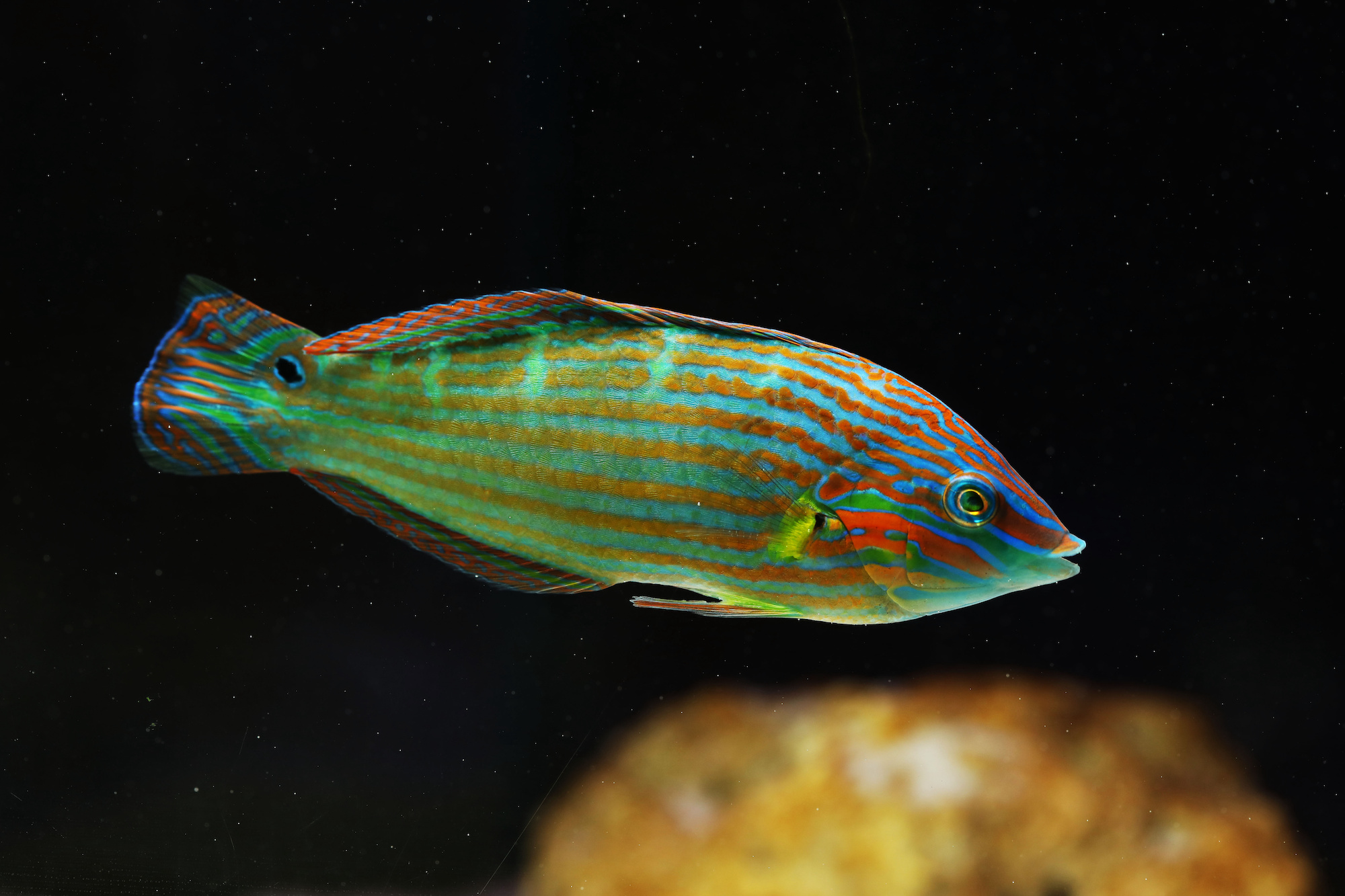
Females of this species have alternating narrow orangeish yellow and blue stripes that span from their heads to their tail fin. They have a blue-edged black spot at the base of their tail fin and another spot in the middle of their dorsal fin. Another spot can be found at the front of their dorsal fin.
The bodies of males have blue-green and orange stripes with three to six narrow blue-green bars on the upper side. Their heads are striped, alternating between pink and blue-green. Their tail fin is blue with curved orange-red bands and a large vertical black spot. There is also a large yellow spot and a smaller black spot at the base of the males’ pectoral fin.
Tail-spot wrasse are small fish, growing to a maximum length of about 12 cm.
Habitat
Shallow coral reefs and rocky shores.
Diet
Small invertebrates such as polychaetes, copepods, isopods and forams.
Life History
Like most wrasse species, the tail-spot wrasse begins its life as female and are able to change their sex to male at some point in their life. Once a female begins its transition to male, they undergo two phases, initial and terminal. Initial phase males spawn in large groups. Males in the terminal phase establish mating territories and pair-spawn with females. During this transition the tail-spot wrasse also changes color with males becoming larger and brighter than females.
The tail-spot wrasse form social groups called harems with one male and several females. Females often move between different males’ territories to change their mates.
Males perform courtship rituals which are followed by eggs and sperm being released into the water. Fertilized eggs then float and disperse by ocean currents. Once the eggs hatch, the tail-spot wrasse enter a larval stage which was recorded to last about 22 days. Then the tail-spot wrasse settles in coral reefs and rocky shores.
IUCN Status
Least Concern
Ecosystem & Cultural Importance
The tail-spot wrasse plays a role in ecosystem balance as a predator of small invertebrates. They help control these populations which contributes to the health of coral reefs.
Found in the western Pacific, from the Ryukyu Islands, southern Japan south to the Great Barrier Reef in the east and the Kimberleys in the west of Australia and east to Samoa and Tonga.
This animal is not native to the Oregon Coast, however is found in the larger Pacific Ocean. It lives in the Aquarium as part of our Connected Coasts gallery.
When looking for a mate, females of this species prefer larger and brighter males.
Citations & Other Resources
Cabanban, A., J.H. Choat, D. Pollard, and R. Myers. 2010. Halichoeres melanurus. The IUCN Red List of Threatened Species 2010.
Myers, R. F. 1991. Micronesian reef fishes : a practical guide to the identification of the coral reef fishes of the tropical central and western Pacific (2nd ed.). Coral Graphics.
Randall, J. E., G.R. Allen, and R.C. Steene. 1990. Fishes of the Great Barrier Reef and Coral Sea. University of Hawaii Press.
Groover, E. M., M.M. Alo, S.W. Ramee, T.N. Lipscomb, J.-M.L.A.Degidio, and M.A. DiMaggio. 2021. Development of early larviculture protocols for the melanurus wrasse Halichoeres melanurus. Aquaculture, 530, 735682-. https://doi.org/10.1016/j.aquaculture.2020.735682
Kuwamura, T., K. Karino, and Y. Nakashima. 2000. Male morphological characteristics and mating success in a protogynous coral reef fish, Halichoeres melanurus. Journal of Ethology, 18(1), 17–23. https://doi.org/10.1007/s101640070019
Sakai, Y., K. Karino, Y. Nakashima, and T. Kuwamura. 2002. Status-dependent behavioural sex change in a polygynous coral-reef fish, Halichoeres melanurus. Journal of Ethology, 20(2), 101–105. https://doi.org/10.1007/s10164-002-0060-0
We use cookies to improve your experience and see how our guests are navigating the website. If this is alright by you, hit 'Accept All', or 'Settings' to customize and learn more.
Read our cookie policy