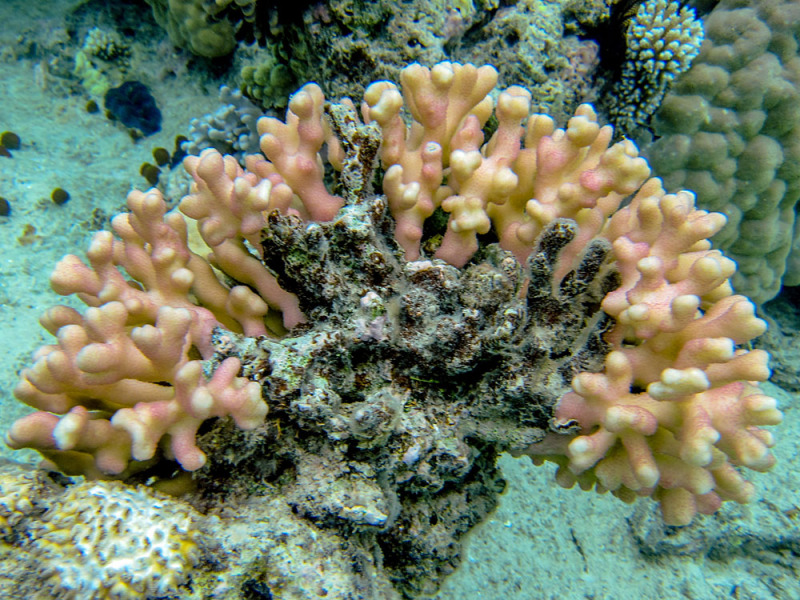
Members of this genus are branching corals. Their branches vary in width with rounded and blunt tips.
Stylophora corals vary in color including cream, pink, or green.
Colonies are covered with polyps. At adulthood an Stylophora pistillatacolony has up to tens of thousands of polyps, each about 1-2 mm in diameter. Each polyp has a ring of tiny tentacles.
Habitat
Coral reefs
Diet
Stylophora coral receives most of its nutrients from its relationship with zooxanthellae, a type of algae that performs photosynthesis and lives within the coral.
Life History
Stylophora species are hermaphrodites meaning individuals have both male and female reproductive organs. Eggs are brooded inside the parent polyp until they are fertilized by sperm from another colony. Once fertilized they are released as planula larvae. The larvae disperse and eventually settle, forming a new polyp.
IUCN Status
Ecosystem & Cultural Importance
As reef-building corals, species belonging to the Stylophora genus are important to the structure of reefs and provide habitat for a variety of marine species.
This animal is not native to the Oregon Coast, however is found in the larger Pacific Ocean. It lives in the Aquarium as part of our Connected Coasts gallery.
Several Stylophora corals including Stylophora pistillata are used to study various aspects of reef biology and ecology.
Citations & Other Resources
Ryan McMinds (https://commons.wikimedia.org/wiki/File:Stylophora_pistillata,_coralitos.jpg), „Stylophora pistillata, coralitos“, https://creativecommons.org/licenses/by/3.0/legalcode
Ryan McMinds (https://commons.wikimedia.org/wiki/File:Stylophora_pistillata,_isla_Lizard.jpg), „Stylophora pistillata, isla Lizard“, https://creativecommons.org/licenses/by/3.0/legalcode
Veron, J. E. N. 1986. Corals of Australia and the Indo-Pacific. Angus & Robertson, North Ryde, NSW, Australia.
Maor‐Landaw, K., S. Karako‐Lampert, H.W. Ben‐Asher, S. Goffredo, G. Falini, Z. Dubinsky, O. Levy. 2014. Gene expression profiles during short‐term heat stress in the red sea coral Stylophora pistillata. Global Change Biology, 20(10), 3026–3035. https://doi.org/10.1111/gcb.12592
Moya, A., S. Tambutté, E. Tambutté, D. Zoccola, N. Caminiti, and D. Allemand. 2006. Study of calcification during a daily cycle of the coral Stylophora pistillata : implications for `light-enhanced calcification. Journal of Experimental Biology, 209(17), 3413–3419. https://doi.org/10.1242/jeb.02382
Flot, J.-F., J. Blanchot, L. Charpy, C. Cruaud, W.Y. Licuanan, Y. Nakano, C. Payri, and S. Tillier. 2011. Incongruence between morphotypes and genetically delimited species in the coral genus Stylophora: phenotypic plasticity, morphological convergence, morphological stasis or interspecific hybridization? BMC Ecology, 11(1), 22–22. https://doi.org/10.1186/1472-6785-11-22
Boutet, A., and B. Schierwater. 2022. Handbook of Marine Model Organisms in Experimental Biology : Established and Emerging (First edition.). Taylor & Francis. https://doi.org/10.1201/9781003217503
Wood, E. M. 1983. Reef corals of the world : biology and field guide. T.F.H. Publications.
We use cookies to improve your experience and see how our guests are navigating the website. If this is alright by you, hit 'Accept All', or 'Settings' to customize and learn more.
Read our cookie policy