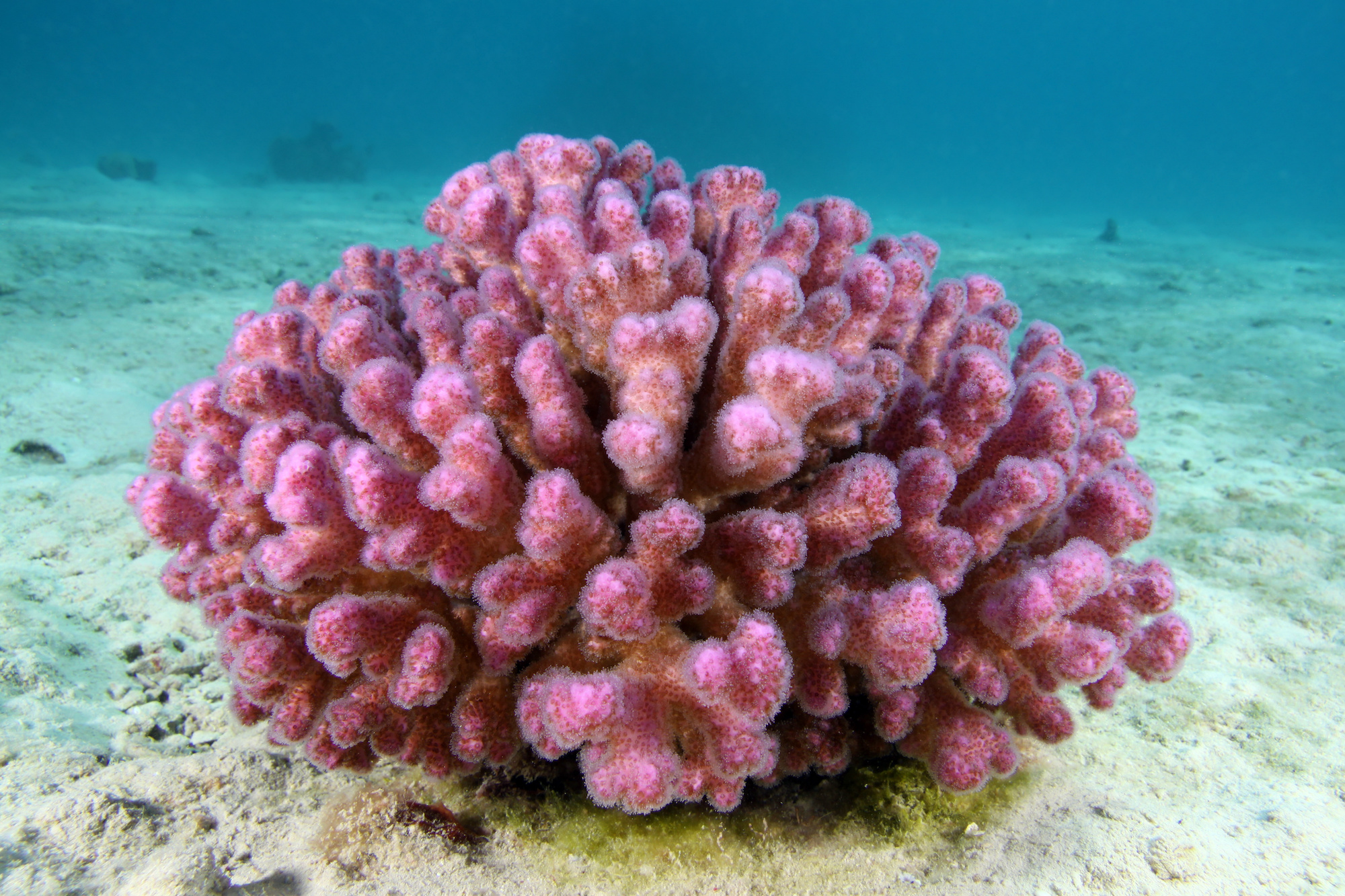
Pocillopora corals are commonly referred to as cauliflower corals
At the Aquarium
Connected Coasts
Appearance
Pocillopora colonies are covered with bumps called verrucae. On shallow reefs exposed to heavy waves, species of Pocillopora are relatively small, while in deeper water their branches are thin and open. Branches also usually have rounded tips.
Color varies between shades of green, brown and yellow, but pink is also common.
Each polyp has a ring of 12 small tentacles which usually extend at night.
Habitat
Coral reefs
Diet
Pocillopora coral receives most of its nutrients from its relationship with zooxanthellae, a type of algae that performs photosynthesis and lives within the coral.
Life History
Species of the Pocillopora genus have been observed to reproduce both sexually and asexually. Sexual reproduction is done by either releasing eggs and sperm into the water, or internally brooding larvae inside the coral polyp. Larvae called planulae then disperse, settle, and form a new polyp.
Several species of this coral genus are hermaphrodites, meaning that an individual has both male and female reproductive organs.
IUCN Status
Endangered
Ecosystem & Cultural Importance
Pocillopora are reef-building corals, acting as the foundation for reef ecosystems and providing habitat for numerous fish and invertebrate species.
Pocillopora species are among the most at risk reef-building corals to climate change.
This animal is not native to the Oregon Coast, however is found in the larger Pacific Ocean. It lives in the Aquarium as part of our Connected Coasts gallery.
Pocillopora is often the research “guineapig” of the coral world. Most of the early discoveries about the growth and reproduction of corals were made with Pocillopora damicornis.
Citations & Other Resources
Veron, J. E. N. 1986. Corals of Australia and the Indo-Pacific. Angus & Robertson, North Ryde, NSW, Australia.
Pinzón, J. H., E. Sampayo, E. Cox, L.J. Chauka, C.A. Chen, C.R. Voolstra, T.C. LaJeunesse, and C. Maggs. 2013. Blind to morphology: genetics identifies several widespread ecologically common species and few endemics among Indo-Pacific cauliflower corals
(Pocillopora, Scleractinia). Journal of Biogeography, 40(8), 1595–1608. https://doi.org/10.1111/jbi.12110
Paz-García, D. A., M.E. Hellberg, F.J. García-de-León, E.F. Balart, and M.A. McPeek. 2015. Switch between Morphospecies of Pocillopora Corals. The American Naturalist, 186(3), 434–440. https://doi.org/10.1086/682363
Combosch, D. J., and S.V. Vollmer. 2013. Mixed asexual and sexual reproduction in the Indo‐Pacific reef coral Pocillopora damicornis. Ecology and Evolution, 3(10), 3379–3387. https://doi.org/10.1002/ece3.721
Fiesinger, A., C. Held, F. Melzner, L. Putchim, T.B.H. Reusch, A.L. Schmidt, and M. Wall. 2023. Population genetic differentiation of the ubiquitous brooding coral Pocillopora acuta along Phuket Island reefs in the Andaman Sea, Thailand. BMC Ecology and Evolution, 23(1), 42–18. https://doi.org/10.1186/s12862-023-02153-7
Wood, E. M. 1983. Reef corals of the world : biology and field guide. T.F.H. Publications.
We use cookies to improve your experience and see how our guests are navigating the website. If this is alright by you, hit 'Accept All', or 'Settings' to customize and learn more.
Read our cookie policy