Other Common Names There are no other common names for this genus, however the many species belonging to Turbinaria go by many different names including disc coral, scroll coral, cup coral and vase coral.
There are no other common names for this genus, however the many species belonging to Turbinaria go by many different names including disc coral, scroll coral, cup coral and vase coral.
At the Aquarium
Connected Coasts
Appearance
Some species of Turbinaria vary in appearance so much so that colonies growing in shallow water have almost no similarities with colonies of the same species in deeper water. Differences in appearance of the same species is due to differences in available light.
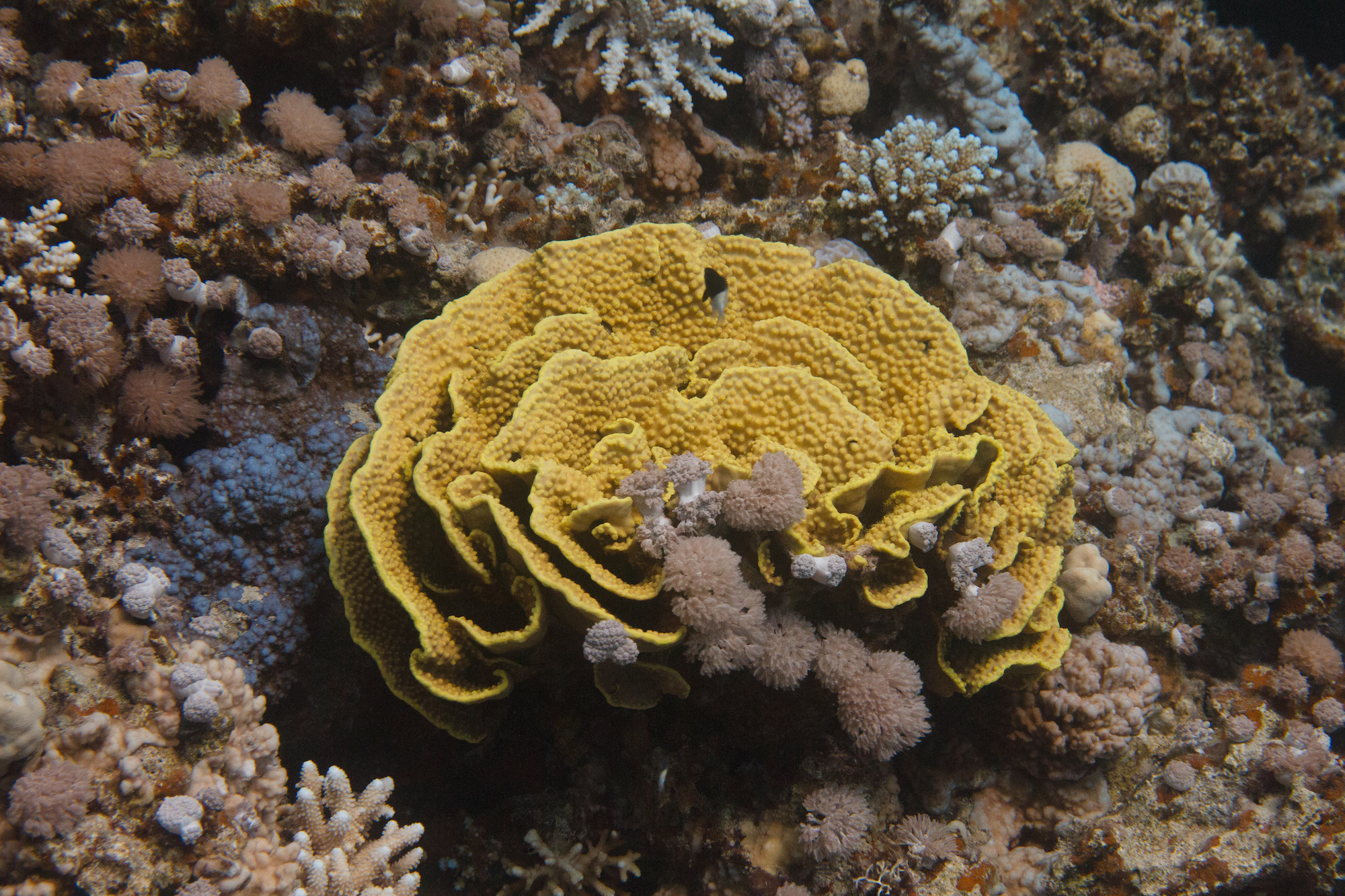
Turbinaria often form vase-shaped or leaf-like folds. Colonies are usually about 20 to 50 cm in diameter but may be larger. The coral as a whole is generally brownish but the polyps and tentacles may be more brightly colored. Polyps are often bright yellow or white. When extended the tentacles have a flower-like appearance.
The corallites, the skeleton of an individual polyp, are round and may be present on both sides of the leaf-like folds.
Habitat
Coral Reefs
Diet
Turbinaria coral receives most of its nutrients from its relationship with zooxanthellae, a type of algae that performs photosynthesis and lives within the coral. Turbinaria coral also receives nutrients from small food particles drifting in the water including zooplankton.
Life History
Unlike most corals, Turbinaria coral breed in the autumn when the sea temperature falls. Corals belonging to this genus have separate sexes and release sperm and eggs into the water for external fertilization.
The fertilized eggs develop into free-floating larvae called planulae. Planulae swim upward toward the light and are carried by ocean currents. They eventually swim back down to the bottom. If conditions are favorable they will settle, developing into polyps and forming colonies.
IUCN Status
Least Concern, Vulnerable
Ecosystem & Cultural Importance
As a stony coral, Turbinaria coral are foundational to coral reef ecosystems since they form habitats for a wide range of marine life.
This animal is not native to the Oregon Coast, however is found in the larger Pacific Ocean. It lives in the Aquarium as part of our Connected Coasts gallery.
Turbinaria coral differ from some other corals since they can successfully grow and live in places of higher latitude. There are 13 species belonging to the genus Turbinaria.
Citations & Other Resources
Béraud, E., F. Gevaert, C. Rottier, and C. Ferrier-Pagès. 2013. The response of the scleractinian coral Turbinaria reniformis to thermal stress depends on the nitrogen status of the coral holobiont. Journal of Experimental Biology, 216(Pt 14), 2665–2674. https://doi.org/10.1242/jeb.085183
Veron, J. E. N. 1986. Corals of Australia and the Indo-Pacific. Angus & Robertson, North Ryde, NSW, Australia.
Ross, C. L., V. Schoepf, T.M. DeCarlo, and M.T. McCulloch. 2018. Mechanisms and seasonal drivers of calcification in the temperate coral Turbinaria reniformis at its latitudinal limits. Proceedings of the Royal Society. B, Biological Sciences, 285(1879), 20180215–20180215. https://doi.org/10.1098/rspb.2018.0215
Rapuano, H., I. Brickner, T. Shlesinger, E. Meroz-Fine, R. Tamir, and Y. Loya. 2017. Reproductive strategies of the coral Turbinaria reniformis in the northern Gulf of Aqaba (Red Sea). Scientific Reports, 7(1), 42670–42670. https://doi.org/10.1038/srep42670
Shimpi, G. G., N.P. Patel, and S. Haldar. 2019. Molecular species delimitation of reef-building coral genera, Porites and Turbinaria (Anthozoa: Scleractinia), from the intertidal fringing reefs of Gulf of Kutch, India reveals unrecognized diversity. Systematics and Biodiversity, 17(6), 541–557. https://doi.org/10.1080/14772000.2019.1677798
Wood, E. M. 1983. Reef corals of the world : biology and field guide. T.F.H. Publications.
We use cookies to improve your experience and see how our guests are navigating the website. If this is alright by you, hit 'Accept All', or 'Settings' to customize and learn more.
Read our cookie policy