No other common names for the genus, but the many different species of Euphyllia coral go by a variety of names.
At the Aquarium
Connected Coasts
Appearance
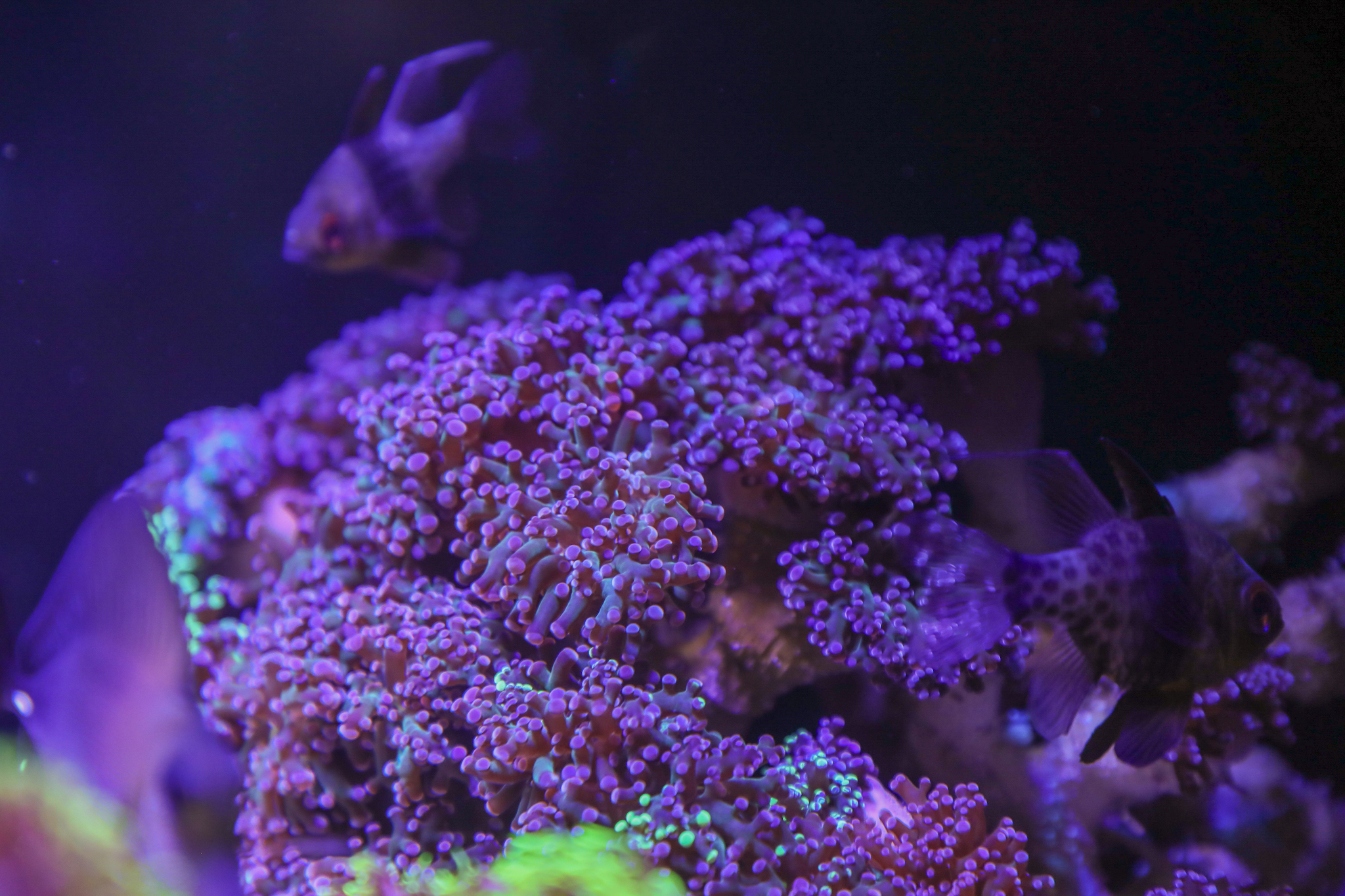
The polyp tentacles of Euphyllia coral are always extended during the day and night. The tentacles are unable to completely retract.
The species of Euphyllia can be differentiated from each other by their unusual tentacles which are large and distinctive. The shapes of tentacle tips vary including round, horseshoe-shaped or branching. Tentacles are green, gray, bluish or pale brown in color, usually with white or green tips. The reason behind the varying tentacle shapes of different species is unknown but it is predicted that it has to do with specialized feeding habits.
Many colonies are 10 cm or less in diameter, but a few may reach 50 cm.
Habitat
Found in a wide variety of reef habitats.
Diet
Euphyllia coral receives most of its nutrients from its relationship with zooxanthellae, a type of algae that performs photosynthesis and lives within the coral. Euphyllia coral also eats organic debris.
Life History
Most species of Euphyllia release eggs and sperm into the water. Eggs become fertilized and once they hatch they develop into larvae called planulae. Planulae float in the ocean currents and eventually swim back down to the bottom. If conditions are favorable they will settle, developing into polyps and forming colonies.
IUCN Status
Vulnerable
Ecosystem & Cultural Importance
All members of the Euphyllia genus have symbiotic relationships with shrimp species.
Euphyllia corals help to create a diverse reef ecosystem and the more diverse a reef is, the more resilient it is.
This animal is not native to the Oregon Coast, however is found in the larger Pacific Ocean. It lives in the Aquarium as part of our Connected Coasts gallery.
Unlike many other corals, Euphyllia corals do not have stinging cells in their tentacles.
Citations & Other Resources
Turak, E., C. Sheppard & E. Wood. 2014. Euphyllia cristata. The IUCN Red List of Threatened Species 2014
Mather, P., I. Bennett, and Australian Coral Reef Society. 1993. A Coral reef handbook: a guide to the geology, flora and fauna of the Great Barrier Reef. 3rd ed. Surrey Beatty & Sons, Chipping Norton, NSW.
Veron, J. E. N. 1986. Corals of Australia and the Indo-Pacific. Angus & Robertson, North Ryde, NSW, Australia.
Wood, E. M. 1983. Reef corals of the world: biology and field guide. T.F.H. Publications, Neptune City, NJ.
We use cookies to improve your experience and see how our guests are navigating the website. If this is alright by you, hit 'Accept All', or 'Settings' to customize and learn more.
Read our cookie policy