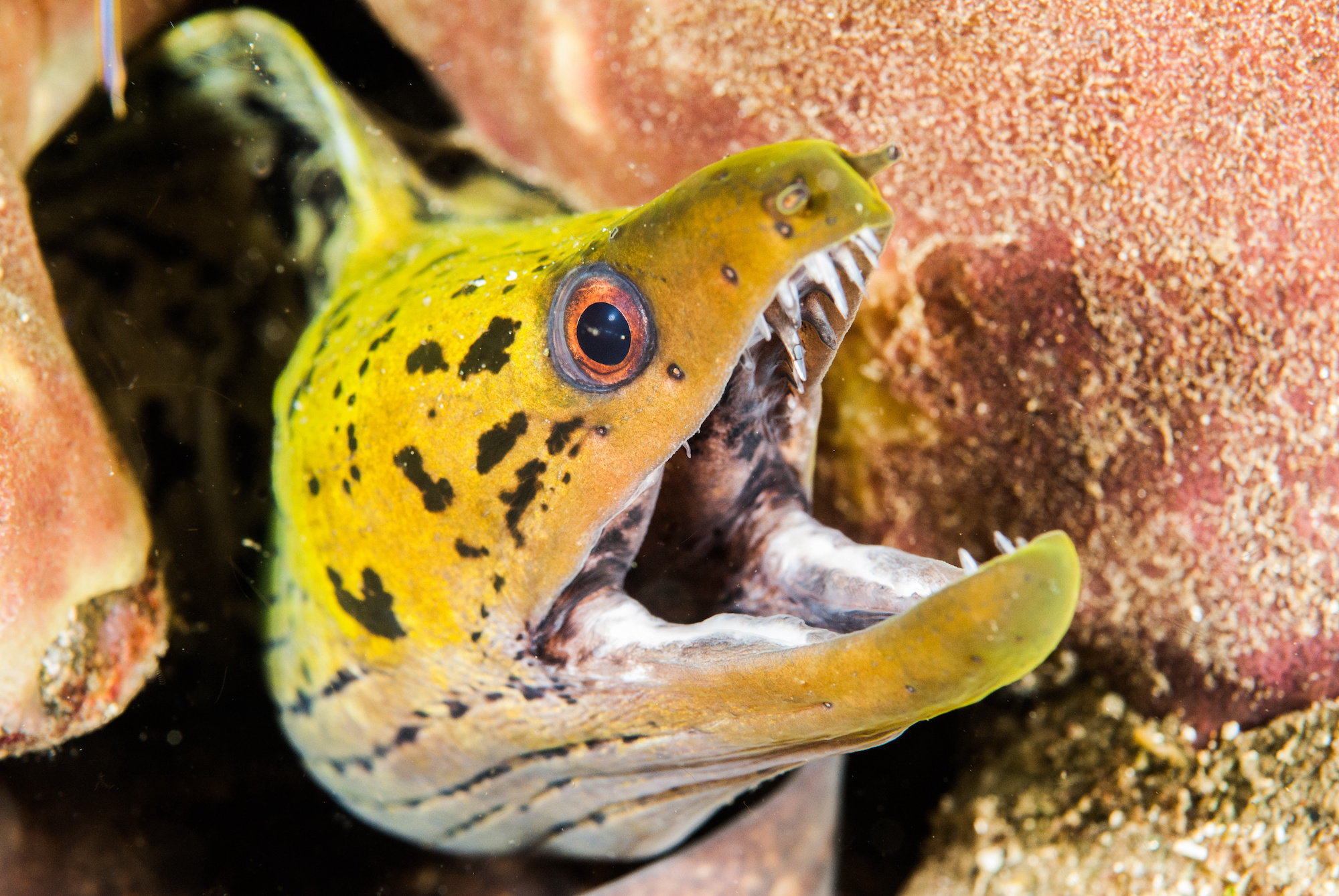
The fimbriated moray is grey to tan in color with scattered black spots on its head and body. The pattern of the spots and their shape varies from individual to individual.
Habitat
Lagoons, reef flats and seaward reefs. Found at depths of 7 to 50 m.
Diet
Fishes and crustaceans.
Life History
Like other moray eels, fimbriated morays reproduce with the female releasing eggs into the water and the male fertilizing them. Once hatched, fimbriated morays undergo a lengthy pelagic larval stage where they drift with ocean currents. These larvae are called leptocephalus.
Eventually fimbriated morays settle in coral reef habitats, preferring the protection of inshore waters among dead corals and small caves.
IUCN Status
Least Concern
Ecosystem & Cultural Importance
Fimbriated morays are important predators in coral reef ecosystems, as they help control a variety of prey populations.
This animal is not native to the Oregon Coast, however is found in the larger Pacific Ocean. It lives in the Aquarium as part of our Connected Coasts gallery.
Like some other moray eels, the fimbriated moray has needle-sharp teeth which has given them a reputation of being dangerous. However, they are just misunderstood! Moray eels are typically shy and reclusive, in most cases they only attack when provoked.
Citations & Other Resources
Smith, D.G., J. McCosker and K. Tighe. 2019. Gymnothorax fimbriatus. The IUCN Red List of Threatened Species 2019.
Myers, R. F. 1991. Micronesian reef fishes : a practical guide to the identification of the coral reef fishes of the tropical central and western Pacific (2nd ed.). Coral Graphics.
Randall, J. E., G.R. Allen, and R.C. Steene. 1990. Fishes of the Great Barrier Reef and Coral Sea. University of Hawaii Press.
Allen, G. R., and Western Australian Museum. 2009. Field guide to marine fishes of tropical Australia and South-East Asia (4th ed.). Western Australian Museum.
We use cookies to improve your experience and see how our guests are navigating the website. If this is alright by you, hit 'Accept All', or 'Settings' to customize and learn more.
Read our cookie policy