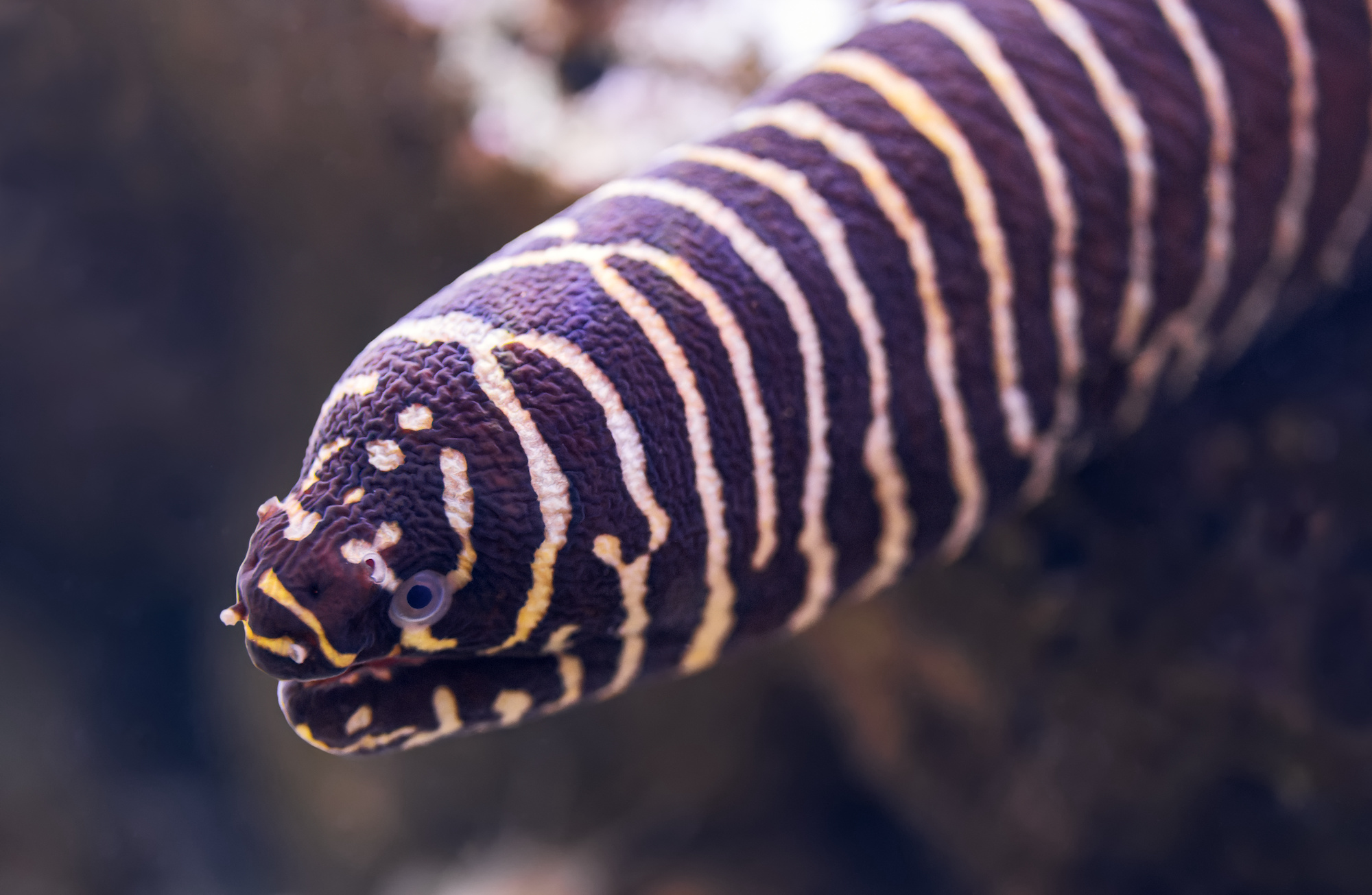
Zebra eels have pebble-like teeth used for crushing hard shelled prey. Zebra eels also have a round and short snout.
As their name might suggest, this species has a unique color pattern of narrow white bands. The zebra eel varies slightly in color from dark brown to orangeish brown.
Zebra eels can grow to lengths of 150 cm.
Habitat
Sandy and rocky bottoms, crevices and ledges of seaward reefs.
Lives at depths of 3 to 50 m.
Diet
Primarily xanthid crabs, but also other crustaceans, molluscs and sea urchins.
Life History
Zebra eels may be considered a protogynous hermaphrodite, meaning they might be born as female and at some point in their lifespan change to male. However, more research is needed to understand zebra eels’ full life history.
Eggs and sperm are released into the water. Once the fertilized eggs hatch, zebra eels begin a lengthy pelagic larval stage where they drift with ocean currents. The larvae are called leptocephalus and are transparent except for their eye color and body wall. While undergoing this stage, they consume dissolved organic carbon and waste products of zooplankton and other larvae.
The larvae continue to grow and eventually settle on the sandy and rocky bottoms of reefs.
IUCN Status
Least Concern
Ecosystem & Cultural Importance
The zebra eel, like other moray eel species, is an important predator in coral reef ecosystems. As a predator, they help maintain prey populations at healthy levels which contributes to the well-being of the entire reef.
In the Indo-Pacific from the Red Sea and East Africa to the Society Islands, north to the Ryukyu and Hawaiian Islands, south to the Great Barrier Reef.
In the eastern central Pacific from southern Baja California, Mexico and from Guatemala to northern Colombia, as well as the Galapagos.
This animal is not native to the Oregon Coast, however is found in the larger Pacific Ocean. It lives in the Aquarium as part of our Connected Coasts gallery.
The zebra eel is the only member of the genus Gymnomuraena.
Citations & Other Resources
Smith, D.G., J. McCosker and K. Tighe. 2019. Gymnomuraena zebra. The IUCN Red List of Threatened Species 2019
Myers, R. F. 1991. Micronesian reef fishes : a practical guide to the identification of the coral reef fishes of the tropical central and western Pacific (2nd ed.). Coral Graphics.
Randall, J. E., G.R. Allen, and R.C. Steene. 1990. Fishes of the Great Barrier Reef and Coral Sea. University of Hawaii Press.
Loh, K.-H., K.-T. Shao, H.-M. Chen, C.-H. Chen, V.-C. Chong, P.-L. Loo, K.-N. Shen, and C.-D. Hsiao. 2016. Next generation sequencing yields the complete mitochondrial genome of the Zebra moray, Gymnomuraena zebra (Anguilliformes: Muraenidae). Mitochondrial DNA. Part A. DNA Mapping, Sequencing, and Analysis, 27(6), 4230–4231. https://doi.org/10.3109/19401736.2015.1022754
We use cookies to improve your experience and see how our guests are navigating the website. If this is alright by you, hit 'Accept All', or 'Settings' to customize and learn more.
Read our cookie policy