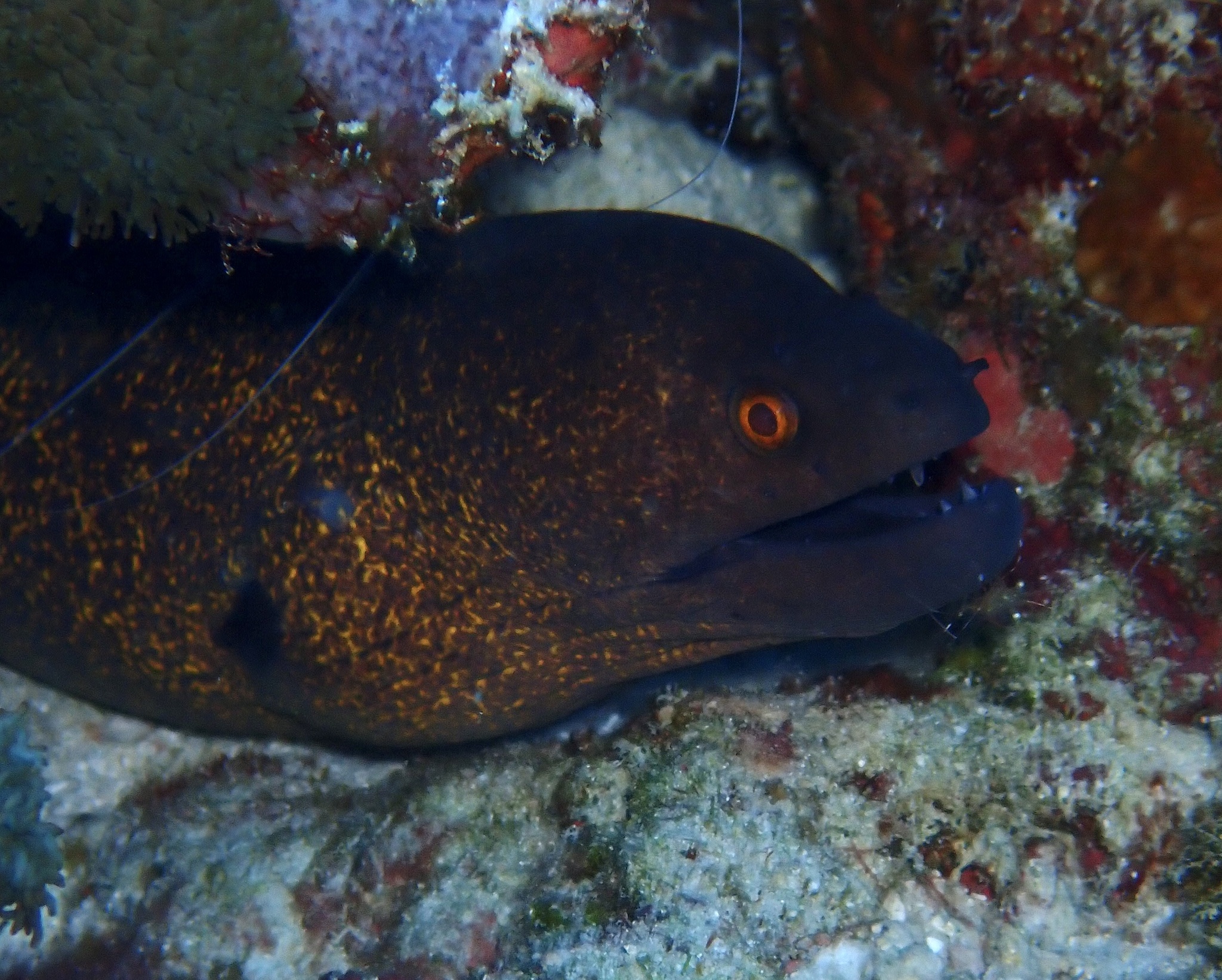
The yellow-edged eel has a distinctive yellowish or greenish edge on its fin that starts above its gill opening and ends shortly after continuing around its tail. Juveniles are yellow with dark brown mottling, appearing like a very ripe banana. Adult’s heads become darker and blotches reduce proportionally as they age and grow. They also have a dark spot around their gill opening.
Yellow-edged eels can reach a maximum length of 1.2 m or 48 inches.
Habitat
Coral reefs and rocky areas of reef flats, from protected shorelines to seaward reefs. Lives at depths of 1 to 150 m.
Diet
Cephalopods, fishes, and crustaceans.
Life History
Female yellow-edged eels release eggs into the water, where the male fertilizes them. Like other morays, yellow-edged eels undergo a lengthy pelagic larval stage where they drift with ocean currents. Moray’s pelagic larval stages are the longest among reef fishes and most species including the yellow-edged eel are widely distributed.
The larvae called leptocephalus are transparent except for their eye color and the body wall which may be only a few cells thick. During this larval stage they consume dissolved organic carbon and fecal pellets and waste products of zooplankton and other larvae.
Eventually the young yellow-edged eels settle in coral reef habitats.
IUCN Status
Least Concern
Ecosystem & Cultural Importance
Yellow-edged eels are considered one of the top predators in tropical reef ecosystems in the Pacific Island Region. As a predator the yellow-edged eel controls other populations, helping to maintain balance in the ecosystem.
Throughout the Indo-Pacific, from the Red Sea to South Africa, east to French Polynesia, north to southern Japan and south to Australia. Also found in the eastern Pacific from Mexico, Costa Rica, Panama, and Ecuador.
This animal is not native to the Oregon Coast, however is found in the larger Pacific Ocean. It lives in the Aquarium as part of our Connected Coasts gallery.
Yellow-edged eels are known to accumulate high levels of ciguatoxins from eating other species that consume microscopic algae called dinoflagellates that produce the toxins. These toxins make their way up the food chain and when yellow-edged eels are consumed by humans it may result in ciguatera fish poisoning and death.
Citations & Other Resources
Smith, D.G., J. McCosker and K. Tighe. 2019. Gymnothorax flavimarginatus. The IUCN Red List of Threatened Species 2019.
Chan, T. Y. K. 2016. Characteristic Features and Contributory Factors in Fatal Ciguatera Fish Poisoning—Implications for Prevention and Public Education. The American Journal of Tropical Medicine and Hygiene 94:704–709.
Kuiter, R. H. 1997. Guide to sea fishes of Australia. New Holland, Frenchs Forest, Australia.
Myers, R. F. 1989. Micronesian reef fishes: a practical guide to the identification of the coral reef fishes of the tropical central and western Pacific. Coral Graphics, Barrigada, Territory of Guam, U.S.A.
Reece, J. S., B. W. Bowen, K. Joshi, V. Goz, and A. Larson. 2010. Phylogeography of Two Moray Eels Indicates High Dispersal Throughout the Indo-Pacific. Journal of Heredity 101:391–402.
We use cookies to improve your experience and see how our guests are navigating the website. If this is alright by you, hit 'Accept All', or 'Settings' to customize and learn more.
Read our cookie policy