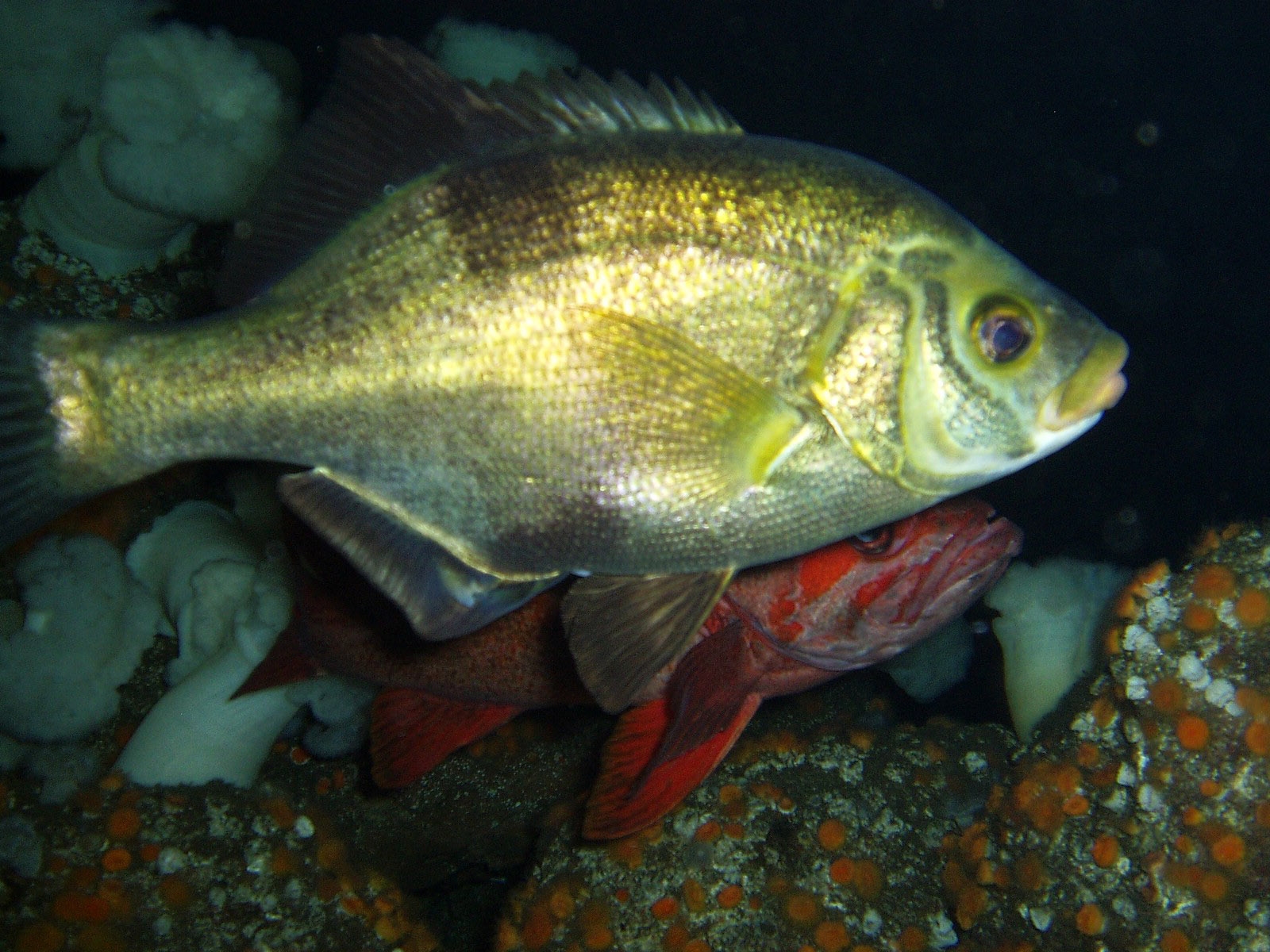
The color of the rubber lip perch varies. Their backs can be iridescent brown, olive, golden, silver or black. Their bellies can be pinkish, purplish, golden or silver. There is often a darker vertical bar in the middle of their body. Juveniles are mostly pinkish.
The rubber lip perch is oval shaped with thick pink to whitish lips.
Rubber lip perches can grow up to 18 inches.
Habitat
Kelp forests and rocky areas including tidepools, bays and harbors. Lives in depths up to 80 m.
Diet
Adults feed on crabs, shrimp and octopus. Juveniles feed on worms, small crabs, mussels and tiny snails.
Life History
Like all surfperch, the rubber lip perch is viviparous meaning females give birth to live young. After being fertilized by a male, the eggs will develop and grow inside the female. After birth these little fish will continue to grow from juveniles into adults.
The rubber lip perch typically forms schools of about fifty fish.
They have a lifespan of 7 to 10 years.
IUCN Status
Not Evaluated
Ecosystem & Cultural Importance
Rubber lip perch are prey for a variety of species including bigger fish, marine mammals, and birds.
Rubber lip perch are common in recreational fishing.
This animal is not native to the Oregon Coast, however is found in the larger Pacific Ocean. It lives in the Aquarium as part of our Connected Coasts gallery.
Their mouths act like a vacuum when they use their flexible lips to clamp onto rocks and suck up their small invertebrate prey.
Citations & Other Resources
California Department of Fish and Wildlife. 2020. Rubberlip Seaperch. Marine Species Portal. https://marinespecies.wildlife.ca.gov/rubberlip-seaperch/false/.
Kells, V. A. 2016. A field guide to coastal fishes. From Alaska to California. Johns Hopkins University Press, Baltimore.
Miller, D. J., and R. N. Lea. 1972. Fish Bulletin 157. Guide To The Coastal Marine Fishes of California.
Snyderman, M. 1998. California marine life: a guide to common marine species. Roberts Rinehart Publishers in cooperation with Monterey Bay Aquarium, Niwot, Colo.
Fritzsche, R.A., and T.J. Hassler. 1989. Species profiles: life histories and environmental requirements of coastal fishes and invertebrates (Pacific Southwest)–pi le perch, striped seaperch, and rubberl ip seaperch. U.S. Fish Wildl. Serv. Biol. Rep. 82(11.103). U.S. Arm~· Corps of Engi:ieers, TR EL-82-4. 15 pp.
We use cookies to improve your experience and see how our guests are navigating the website. If this is alright by you, hit 'Accept All', or 'Settings' to customize and learn more.
Read our cookie policy