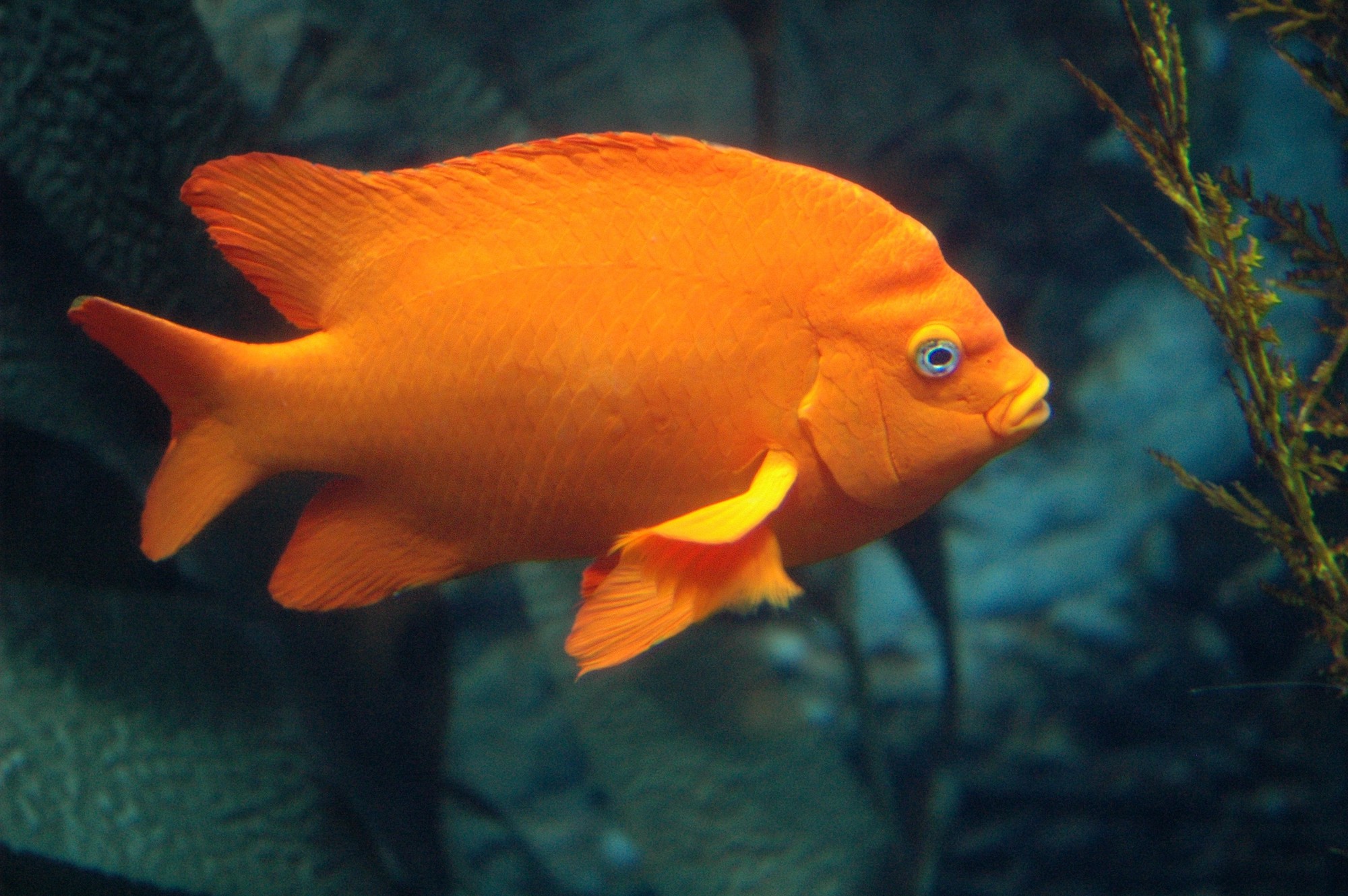
Adult garibaldi are shades of bright orange all over. The edges of their dorsal, anal, and pelvic fins may be bright blue. Their caudal fin is heart shaped. The irises of their eyes are silvery. Older adults appear to have a bump on their forehead. There is little difference in the appearances of female and male garibaldi.
Juveniles are bright orange with many pale to dark blue spots. The edges of their fins are also blue.
Garibaldi can grow to a length of 15 inches.
Habitat
Rocky bottom in clear water near crevices and small caves, occasionally in kelp forests to depths of 30 m.
Diet
Bottom-dwelling invertebrates including worms, small anemones, sponges, bryozoans, crabs, shrimps, small shellfish, and sea stars
Life History
Spawning season is from March through July, with several spawning cycles possibly occurring over the season. An adult male garibaldi creates a nest by clearing an area on the rocks and collecting specific species of red algae. The male works to remove all other algae and debris. After completing the nest, he tries to invite a female to mate by performing an elaborate courtship dance, in which he swims a series of circles around the nest. When he is prepared for the female to come to the nest and lay her eggs, he makes several clicking noises. If the female approves of the male and the nest, she swims over and lays 15,000 to 80,000 bright yellow eggs in the nest site. The male then chases the female away so she won’t eat her own eggs. The male then fertilizes the eggs and defends the nests until the eggs hatch. Several females may deposit eggs in the same nest and a female may deposit eggs in several different nests. Females prefer to lay eggs next to other batches of fresh yellow eggs.
Eggs hatch in two to three weeks. The larvae then disperse and float in the ocean currents. By late summer and fall, young garibaldi can be found in shallow waters.
A garibaldi may live up to 17 years, but their life span is usually about 12 years or less.
IUCN Status
Least Concern
Ecosystem & Cultural Importance
Garibaldi have a symbiotic relationship with a fish called senorita. Senoritas eat small parasites and dead skin off garibaldi. Garibaldi benefit from being rid of the irritants on their skin.
Garibaldi play an important role in kelp forests as both predator and prey for a variety of species. They help keep invertebrates under control and are eaten by larger fish, some sharks, seals and sea lions.
The garibaldi is the California state marine fish. They are protected in California and it is illegal to fish for or possess them without a permit from the California Department of Fish and Wildlife.
This animal is not native to the Oregon Coast, however is found in the larger Pacific Ocean, nearer to California. It lives in the Aquarium as part of our Connected Coasts gallery.
Both female and male garibaldi are highly territorial and will defend their area of the reef from intruders. They do this by making clicking noises and aggressively charging at invaders in their territory.
The garibaldi gets its common name from the 19th century Italian leader by the same name whose famous army wore flashy red/orange colors into battle.
Citations & Other Resources
Allen, G., R. Robertson, and B. Lea. 2010. Hypsypops rubicundus. The IUCN Red List of Threatened Species 2010.
CA Marine Species Portal. (n.d.). . https://marinespecies.wildlife.ca.gov/garibaldi/false/.
Kells, V. A. 2016. A field guide to coastal fishes. From Alaska to California. Johns Hopkins University Press, Baltimore.
Snyderman, M. 1998. California marine life: a guide to common marine species. Roberts Rinehart Publishers in cooperation with Monterey Bay Aquarium, Niwot, Colo.
National Park Service, U.S. Department of the Interior. 2018. Garibaldi – Channel Islands National Park (U.S. National Park Service). https://www.nps.gov/chis/learn/nature/garibaldi.htm.
We use cookies to improve your experience and see how our guests are navigating the website. If this is alright by you, hit 'Accept All', or 'Settings' to customize and learn more.
Read our cookie policy