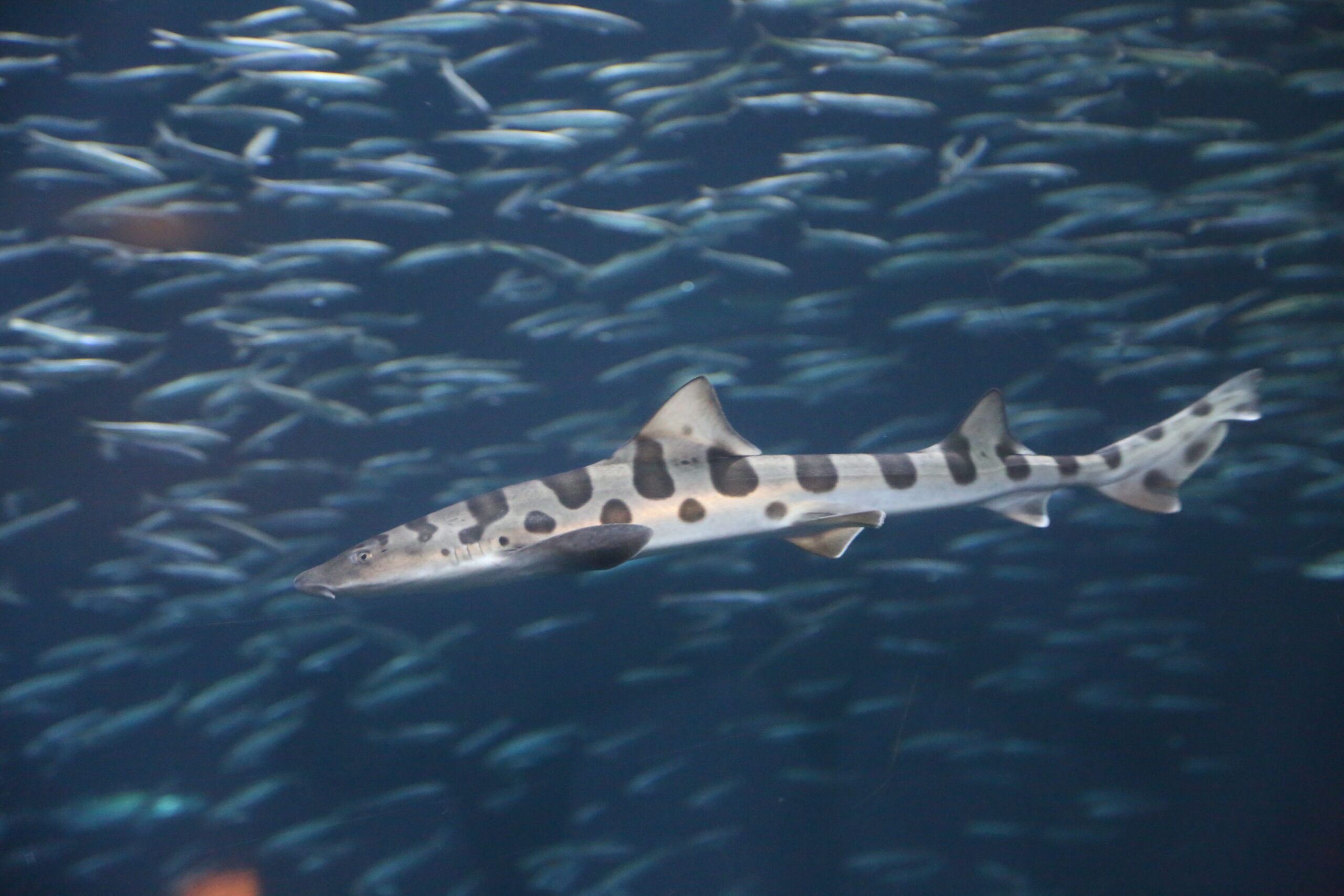
Leopard sharks are pale to greyish above and whitish below. They have a unique color pattern of dark saddle bars inter-spaced with dark spots that stretch in a row across its back. As they age, the dark spots pale in the center.
Their snouts are broad and short. They can also be recognized by their triangular pectoral fins and long, tapered tail.
Leopard sharks grow to lengths of 4 to 7 feet and weigh up to 40 pounds. Females are larger than males.
Habitat
Shallow waters of bays and estuaries and nearshore in kelp forests, rocky reefs and sandy environments.
Rarely found in water more than 65 feet deep but some have been recorded to go as deep as 300 feet.
Diet
Variety of fishes and invertebrates like anchovies, squid or crab. As leopard sharks age they eat more fish and fewer crabs.
Life History
During the spring and summer leopard sharks live in bays and estuaries. Then during the winter they often move out of the bays to coastal waters as salinity and temperature decrease. Their movements are strongly influenced by the tidal cycle. They swim with tidal currents to reduce using energy associated with swimming. During incoming tides they move into shallow mudflats to forage and then as the tide goes out they retreat to deeper water. They are often found in groups and swim together with other shark species.
A female leopard shark is usually about 10 years old when she has her first litter. After that, a female will generally mate every year. Males mature between 7 and 13 years.
Leopard sharks are viviparous. A female leopard shark keeps her eggs inside her body until they hatch. She gives birth to 7 to 36 live offspring that are each about 7 inches long.
Bays and estuaries are important nursery areas, particularly in central and northern California. Females move to shallow warm habitats, often over sand or mudflats to give birth. In central and northern California, young leopard sharks are often found in sheltered, shallow, inshore areas such as bays, mudflats, and tidal creeks.
Leopard sharks can live up to 25 to 30 years.
IUCN Status
Least Concern
Ecosystem & Cultural Importance
Predators of the leopard shark include the broadnose sevengill shark and marine mammals such as sea lions. Large fish including the white shark also prey upon both juvenile and adult leopard sharks. As predators, leopard sharks help control populations of bottom-dwelling invertebrates.
Leopard sharks are caught by recreational anglers and small-scale commercial fisheries in California open waters. Even though this species is listed as least concern, studies indicate that populations could be vulnerable to overfishing. To prevent overfishing, in California leopard sharks must be 36 inches long for anglers to keep it.
As with other sharks, leopard sharks periodically shed and replace their teeth. When one tooth is lost or damaged, a new one takes its place. Leopard sharks replace their teeth every 9 to 12 days.
Like all sharks, leopard sharks lack the swim bladders that other fish use to fine-tune their buoyancy. A leopard shark stores oil in its big liver which helps counterbalance its weight. This leads the shark to sink whenever it’s not swimming. They remain just a foot or so above the sand.
We use cookies to improve your experience and see how our guests are navigating the website. If this is alright by you, hit 'Accept All', or 'Settings' to customize and learn more.
Read our cookie policy